
Montessori vs play-based early learning: what the approaches actually mean
By Mei Larsen · Updated 2026-08-06
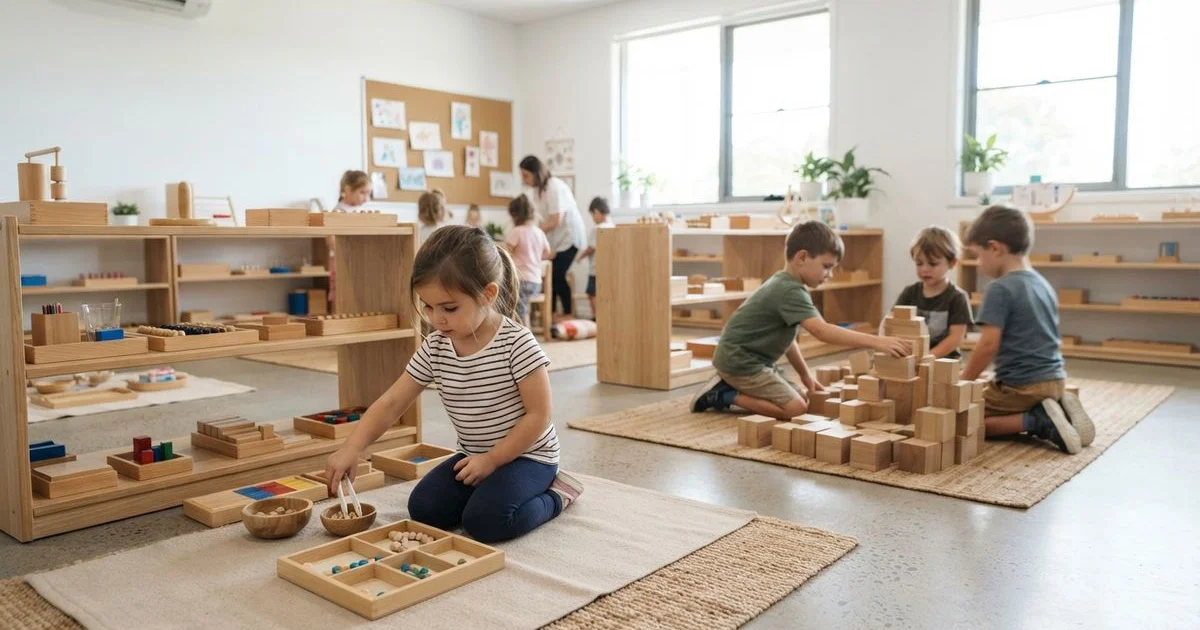
Walk into a Brisbane early learning and Montessori centre and you’ll hear a handful of terms thrown around, Montessori, play-based, Reggio-inspired, that sound meaningfully different but can be hard to tell apart from a website description alone. Here’s what these approaches actually mean in practice, and how to judge what a specific centre genuinely delivers.
What Montessori actually is
Montessori is a specific educational method built around self-directed activity, hands-on learning with purpose-designed materials, and mixed-age classrooms where older children often help younger ones. Educators, sometimes called guides rather than teachers, observe closely and introduce materials when a child seems ready, rather than delivering a set group lesson at a fixed time. Classrooms are typically calm and highly organised, with everything at child height and each material designed to teach one specific concept.
The term isn’t trademarked or regulated in Australia, so how closely a centre follows genuine Montessori principles varies. Some centres are staffed by educators with formal Montessori training and use authentic Montessori materials throughout; others use the label more loosely alongside a broadly play-based approach.
What play-based learning actually is
Most mainstream Australian early learning programs, including those built around the national Early Years Learning Framework, are broadly play-based. Children choose from a range of activities, dress-ups, blocks, art, outdoor play, sensory tables, and educators actively join in, ask questions, and extend the child’s thinking through that play rather than delivering formal lessons. It’s generally less structured than a Montessori classroom, with more group activities and a stronger emphasis on social and imaginative play.
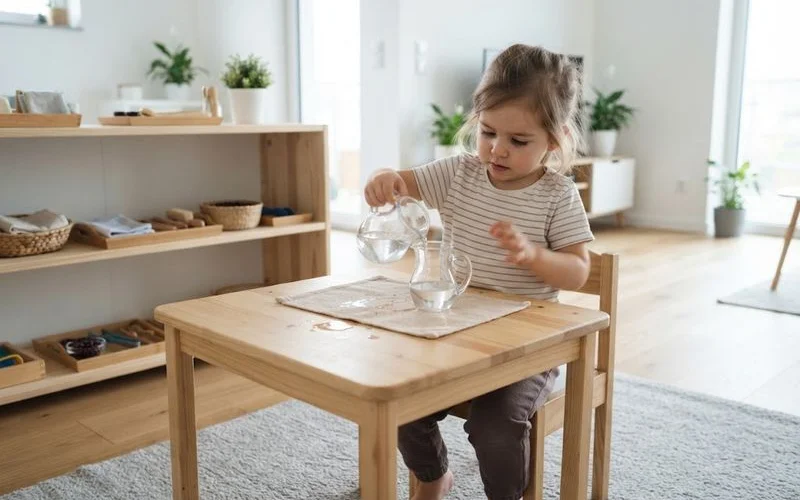
Comparing the two approaches
| Montessori | General play-based | |
|---|---|---|
| Structure | Self-directed, individual pacing | Flexible, more group activities |
| Classroom setup | Purpose-designed materials, mixed ages | Varied play stations, generally single age group |
| Educator role | Observes and introduces materials when ready | Actively joins and extends play |
| Best suited to | Children who enjoy independent, focused tasks | Children who thrive on social, flexible play |
How to tell what a centre actually practises
Ask to observe an active session rather than an empty classroom, and watch how children move between activities. In a genuinely Montessori room, you’ll typically see children working independently or in small groups on specific tasks with real focus, with an educator quietly observing rather than directing. Ask directly about staff Montessori training and qualifications, and how much of the daily program is authentically Montessori versus supplemented with more general play-based activities, since many centres genuinely blend the two.
Choosing based on your child, not the label
The label matters less than how your specific child responds to the environment. A child who gets easily overstimulated by busy group activities may thrive in a calmer, self-paced Montessori setting, while a highly social, energetic child may do better with the flexibility and group interaction of a general play-based program. If you’re unsure, a trial visit where your child can actually spend time in the room is worth more than any brochure description.
Other approaches you might come across
Montessori and general play-based programs are the two most common in Brisbane, but you’ll occasionally see centres describe themselves as Reggio-inspired, which draws on a similar child-led philosophy but places heavier emphasis on documentation of learning, collaborative projects, and the physical environment itself as a teaching tool. Others may describe a forest school or nature-based approach, built around extended outdoor, nature-immersive play rather than a traditional indoor classroom. None of these labels are regulated any more strictly than Montessori, so the same rule applies: ask what it looks like in practice, and observe an actual session before assuming the label tells you everything.
What to ask beyond the philosophy
Regardless of which approach a centre follows, ask how they track and communicate your child’s individual progress, since a strong program of any style should be able to show concrete development over time, not just describe its general philosophy. It’s also worth asking how the approach is applied consistently across different educators in the room, since a philosophy is only as strong as how reliably it’s put into practice day to day.
Compare rated centres on the Brisbane childcare directory, using our methodology to see how they’re scored.
Questions people ask
- Is Montessori better than a standard play-based program?
- Neither is objectively better, they suit different children and different family preferences. Montessori tends to suit children who thrive with structured independence and self-paced tasks, while a general play-based program often suits children who respond well to flexible, social, adult-guided play.
- Do centres need a licence to call themselves Montessori?
- The term Montessori isn't a protected or regulated label in Australia, so it's used with varying levels of genuine fidelity to the method. Ask specifically about staff training and materials to judge how closely a centre actually follows Montessori principles.
- What does play-based learning actually involve?
- It centres on child-led exploration through play, with educators observing and gently extending each child's interests and skills, rather than delivering set lessons. Most mainstream Australian early learning programs, including those following the national Early Years Learning Framework, are broadly play-based.
- Can I visit a Montessori classroom before enrolling to see the difference?
- Yes, and it's the best way to judge fit. Ask to observe a session in progress rather than just seeing an empty room, since the way children move between self-directed tasks is the clearest sign of a genuinely Montessori environment.